Child Water Safety Rules: Essential Tips for Parents of Multiple Kids
Key Takeaways
Child water safety rules are critical for families with multiple children. Learn practical supervision strategies and gear requirements to prevent accidents.
Child Water Safety Rules: Essential Tips for Parents of Multiple Kids
People who believe their child is safe because they can swim a few laps and people who treat every body of water as a potential hazard end up with very different results. The former often relax their guard, assuming that a basic level of proficiency is a shield against accidents. The latter understand that water is an unforgiving environment where even a momentary lapse in judgment can lead to a crisis. This distinction is especially vital for parents of multiple children, where the attention must be split across different ages, temperaments, and skill levels. As a single mother, I have learned that I cannot afford the luxury of a 'relaxed' attitude. Every trip to the pool or beach is a calculated operation where safety protocols are established before we even leave the car.
This article provides general information only. It is not a substitute for professional medical advice, water safety certification, or formal lifeguard training. Always consult with qualified professionals regarding swimming instruction and emergency response protocols. If you are ever in an emergency situation, call your local emergency services immediately.
Why Water Safety Rules for Children Are Non-Negotiable
Ignoring water safety is not just a minor oversight; it has concrete, life-altering consequences. According to the Centers for Disease Control and Prevention (CDC) in 2023, drowning is the leading cause of death for children aged 1–4. These are not just statistics; they represent families that were changed in an instant. The reality is that drowning is often silent. Unlike the splashing and screaming depicted in movies, a struggling child often cannot call for help because their respiratory system is prioritized for breathing, not speech.
For a parent managing two or three children, the risk is compounded. If I am focusing on helping my youngest put on their goggles, I might miss my middle child slipping into a deeper section of the pool. It takes as little as 20–60 seconds for a struggling child to submerge, and permanent brain damage can occur within 4–6 minutes of oxygen deprivation. The consequence of ignoring these rules is the potential for a fatal accident or a non-fatal drowning injury that results in long-term neurological impairment.
Furthermore, the psychological impact of a 'near-miss' can be traumatizing for both the parent and the child. I have seen parents who, after one scare, become so fearful that they avoid water entirely, which prevents the child from ever learning the very skills that could save them. Establishing rigid rules is not about being a 'killjoy'; it is about creating a framework where fun is possible because the risks are managed.
How Can You Manage Multiple Children in the Water Safely?
When you are the sole adult in charge, you need a system that does not rely on luck. I use a multi-layered approach that combines physical barriers, constant supervision, and clear communication.
Implement the 10/20 Rule
The 10/20 rule is a standard used by professional lifeguards, but it is equally effective for parents. You should scan the entire area where your children are every 10 seconds and be close enough to reach the furthest child within 20 seconds. This means you are never more than a few steps away. For example, if my children are in a wading pool, I am sitting on the edge, not on a lounge chair 15 feet away. If they are in a larger pool, I am in the water with them, positioned so I can see all of them in a single horizontal sweep of my eyes.
Use the Touch Supervision Method
For children under the age of 5 or those who are not yet confident swimmers, I follow the 'touch supervision' rule. This means I am always within arm's reach of the child. Specifically, if my youngest is playing near the steps, my hand is either on them or close enough to grab them instantly if they slip. When you have multiple kids, this might mean the older ones must stay in the shallow area with you, even if they want to go deeper. Safety dictates that the group stays together based on the needs of the least capable swimmer.
Verify Equipment and Gear
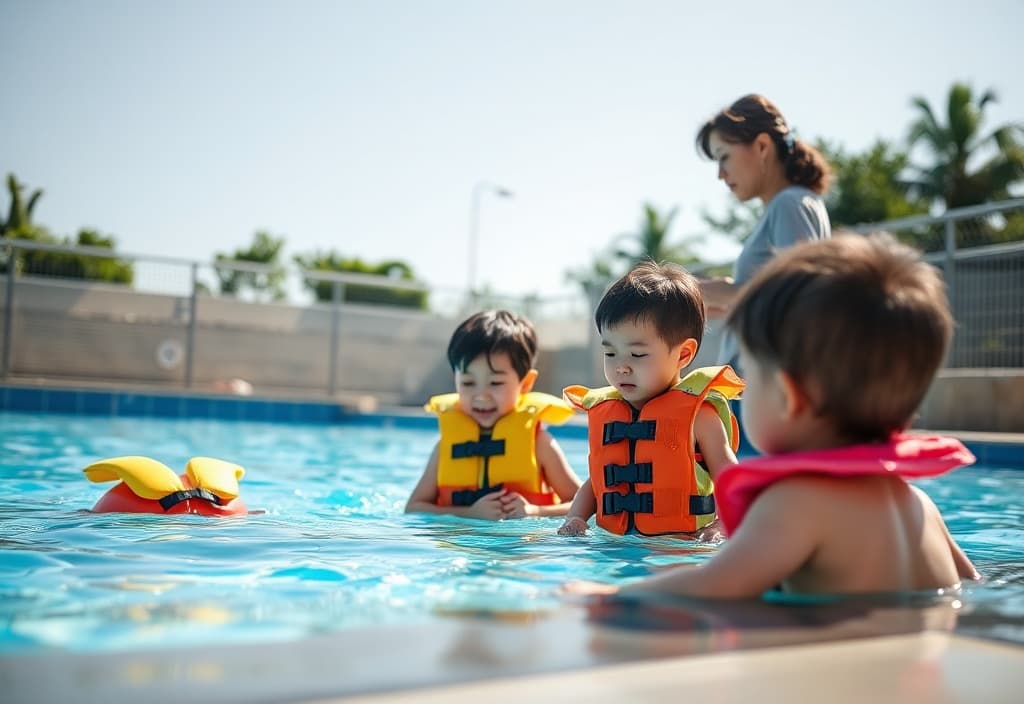
Not all flotation devices are created equal. Many parents rely on 'water wings' or inflatable rings, but these are toys, not safety devices. They can easily deflate or slip off. In practice, I only trust U.S. Coast Guard (USCG)-approved life jackets (Type I, II, or III).
- Check the Label: Ensure the jacket is USCG-approved for the child's weight.
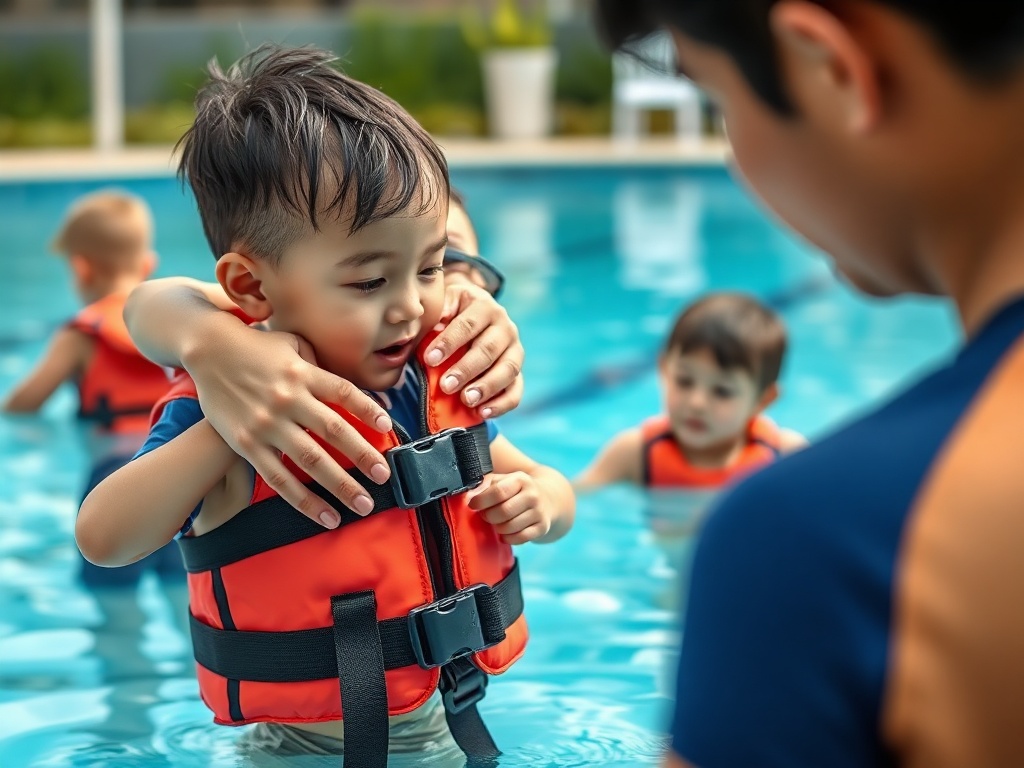
- Test the Fit: Lift the child by the shoulders of the life jacket. If their chin or ears slip through the neck opening, the jacket is too loose.
- Maintain the Gear: Inspect buckles and straps for wear before every trip.
Establish Clear Boundaries and 'Out of Water' Rules
Before we enter any pool area, I set the 'dry land' rules. For example, no child enters the water until I have given the verbal 'green light.' If I am busy setting up the towels or applying sunscreen, they must sit on the bench with their hands on their knees. We also have a 'whistle rule'—if I blow a whistle or call a specific code word, everyone must exit the water immediately, no questions asked. This level of discipline is essential when you are outnumbered by your children.
Three Common Mistakes Parents Make Near the Water
Even well-meaning parents often fall into traps that compromise safety. Recognizing these mistakes is the first step toward fixing them.
Relying on Older Siblings for Supervision
A common mistake in larger families is asking an 8-year-old to 'watch' a 4-year-old. This is a recipe for disaster. Children do not have the situational awareness or the physical strength to perform a rescue. An older child might get distracted by a toy or a friend, leaving the younger child vulnerable. Fix this by accepting that you, the adult, are the only designated 'Water Watcher.' If you must step away—even for a bathroom break—everyone comes out of the water and sits with you. There are no exceptions to this rule.
The 'False Sense of Security' from Swim Lessons
Many parents believe that because their child has completed a level of swim lessons, they are now 'safe.' However, a child who can swim 15 meters in a calm, heated indoor pool may panic in a cold lake or a crowded public pool with splashing water. Personal observation has shown me that panic can override skill in seconds. Fix this by treating every child as a 'non-swimmer' in terms of supervision level, regardless of their certificates. Swim lessons are a layer of protection, not a replacement for an adult's eyes.
Distraction by Technology and Socializing
It takes only 30 seconds for a child to lose consciousness underwater. In the time it takes to reply to a text message or post a photo of the kids on social media, a life-threatening event can occur. In my experience, 'inattentional blindness' is real; you can be looking in the direction of the pool but not actually 'seeing' the struggle because your mind is on your phone. Fix this by putting your phone in a 'dry bag' inside your backpack and leaving it there. If you are with other parents, do not get caught in deep conversation. If you are talking, you are not watching.
Critical Caveats: When the Advice May Not Apply
While the tips above are standard, there are situations where they may fail or require adjustment. For instance, in extremely crowded public water parks, the 10/20 rule becomes much harder to implement because of the visual 'noise' of hundreds of other people. In such cases, the standard advice of 'just watch them' is insufficient. You may need to use bright, neon-colored swimsuits (orange or lime green) to distinguish your children from the crowd. If the water is so crowded that you cannot see the bottom, the risk level increases significantly, and it may be safer to keep the children in a less populated area or stick to the splash pad.
Additionally, these rules assume the children are healthy. If a child has a history of seizures or other medical conditions, the supervision must be even more intensive, often requiring 1:1 in-water support regardless of age. You must also consider the environment. A 'safe' backyard pool can become a death trap if the drain covers are old or broken, leading to suction entrapment. Always verify that pool drains meet current safety standards (such as the Virginia Graeme Baker Pool and Spa Safety Act requirements) before allowing children to swim.
Decision Criteria for Parents
When deciding how to approach a day at the water, consider these two criteria:
The Environment vs. Skill Ratio: Is the water condition (waves, temperature, clarity) within the child's demonstrated (not theoretical) ability? If the environment is more challenging than their usual practice spot, increase the supervision level by one tier.
The Adult-to-Child Ratio: If you are alone with three children, you cannot provide 1:1 touch supervision for all of them simultaneously. In this scenario, the 'lowest common denominator' rule applies: the entire group stays in the safest, shallowest area that the youngest child can handle.

Summary and Next Steps
Managing water safety for multiple children requires a shift from a 'leisure' mindset to a 'safety-first' mindset. It is a demanding task that requires constant vigilance, but it is the only way to ensure that your family outings remain joyful memories rather than tragedies.
- Supervision is active: Use the 10/20 rule and touch supervision for young children; never rely on older siblings or a child's swimming ability as a substitute for your own eyes.
- Gear must be certified: Use only USCG-approved life jackets and avoid inflatable toys as safety devices.
- Discipline is key: Establish 'out of water' rules and emergency signals before anyone enters the pool area. Your immediate action today: Check the labels on your children's flotation devices. If they are not USCG-approved or if they no longer fit correctly, set them aside and purchase properly rated safety gear before your next trip to the water. You can find more details in child safety gear guides or by reviewing emergency response protocols provided by certified organizations. Before your next outing, verify the safety features of your destination. If it is a public pool, call ahead to ask about lifeguard staffing. If it is a private pool, check for secure fencing. If you cannot verify these safety layers, pause your plans until you can choose a safer location.
Previous
Child media exposure standards: A guide for new parents
Next
Child Water Safety Rules: Essential Tips for Parents of Multiple Kids
More in Parenting

A Working Parent's Guide to Children's Eye Care: Protecting Your Firstborn's Vision
A practical guide for busy working parents on protecting their firstborn's vision. Learn how to spot early warning signs, set up healthy home lighting, and build simple routines.

Is It Puberty Rebellion or Teen Anxiety? A 2-Week Guide for Exhausted Parents
Unsure if your teenager is going through normal puberty or experiencing deep emotional anxiety? Discover the 2-week observation method and a daily 5-minute checklist.

Childhood Hives Causes and Management for School-Aged Kids
Childhood hives can be triggered by stress, temperature, or infection. Learn how to manage triggers and decide when your child is ready for school or daycare.

Side Dish Refusal in Toddlers: Strategies for Multi-Child Homes
Learn why children refuse side dishes after a second baby arrives and how to manage picky eating with age-specific strategies and consistent mealtime routines.