Side Dish Refusal in Toddlers: Strategies for Multi-Child Homes

Key Takeaways
Learn why children refuse side dishes after a second baby arrives and how to manage picky eating with age-specific strategies and consistent mealtime routines.
Side Dish Refusal in Toddlers: Strategies for Multi-Child Homes
Have you ever spent 40 minutes preparing a nutritious meal only for your child to eat only the plain rice and ignore every single side dish you painstakingly prepared? This situation is frustrating for any parent, but I have found that it becomes exponentially more complex when you are also balancing the needs of a newborn or a second child. As a stay-at-home dad currently on parental leave, I have spent countless hours observing the shifting dynamics at our dinner table. What I initially thought was just a phase of picky eating turned out to be a deeply layered response to changes in our family structure and developmental milestones.
This article provides general information only and does not constitute medical, nutritional, or veterinary advice. Please consult a pediatrician or a qualified nutrition specialist regarding your child's specific dietary needs or any concerns regarding growth and development.
The Core Answer: Why Children Refuse Side Dishes
When a child suddenly refuses side dishes—often referred to as 'banchan' in many households—the primary reason is rarely the food itself. In my experience, and supported by child development theories such as the Division of Responsibility in Feeding, the refusal is usually a bid for autonomy or a reaction to a significant life change, such as the birth of a second child. When a new baby arrives, the older child often feels a loss of control and a reduction in the one-on-one attention they previously enjoyed. Controlling what goes into their mouth is one of the few ways a toddler can assert independence and command the undivided attention of their parents, even if that attention is negative.
Specifically, I have observed that children often regress to 'safe' foods like plain rice, bread, or milk because these foods are predictable in texture and flavor. Unlike a seasoned vegetable side dish or a complex protein, white rice is consistent every time. For a child dealing with the emotional upheaval of a new sibling, this consistency provides a form of sensory security. To address this, parents must shift their focus from 'making the child eat' to 'creating a pressure-free environment' where the child feels safe enough to explore variety again.
The Impact of a Second Child on Mealtime Dynamics
In my household, the arrival of our second child changed everything about how our oldest approached the dinner table. Suddenly, the toddler was no longer the sole focus of the meal. If the baby was crying or being fed at the same time, the older child would often use food refusal as a tool to bring the focus back to them. I noticed that the 'side dish strike' became more frequent during the first 3–6 months after the birth.
The Attention Trap
When I would plead with my child to 'just try one bite of the spinach,' I was inadvertently rewarding the refusal with high-intensity attention. From the perspective of a toddler who is missing their dad's full focus, a 5-minute negotiation over a piece of broccoli is a win. I have found that the most effective way to break this cycle is to provide neutral, calm attention during the meal regardless of what is being eaten, and to save the high-intensity praise for non-food-related behaviors later in the day.
Sibling Modeling and Regression
It is also common for an older child to see the baby only drinking milk and decide they want to do the same. This regression is a normal psychological response. According to a 2021 survey by the C.S. Mott Children's Hospital, about 15% of parents reported that their older children showed signs of behavioral regression after a new sibling was born. At the dinner table, this might look like a 3-year-old demanding to be spoon-fed or refusing any food that requires significant chewing, preferring the 'easy' textures that resemble the baby's diet.
Age-Specific Differences in Selective Eating
Understanding the developmental stage of your child is crucial for setting realistic expectations. A 15-month-old's refusal is biologically different from a 4-year-old's refusal.
The 12–24 Month Window: Neophobia
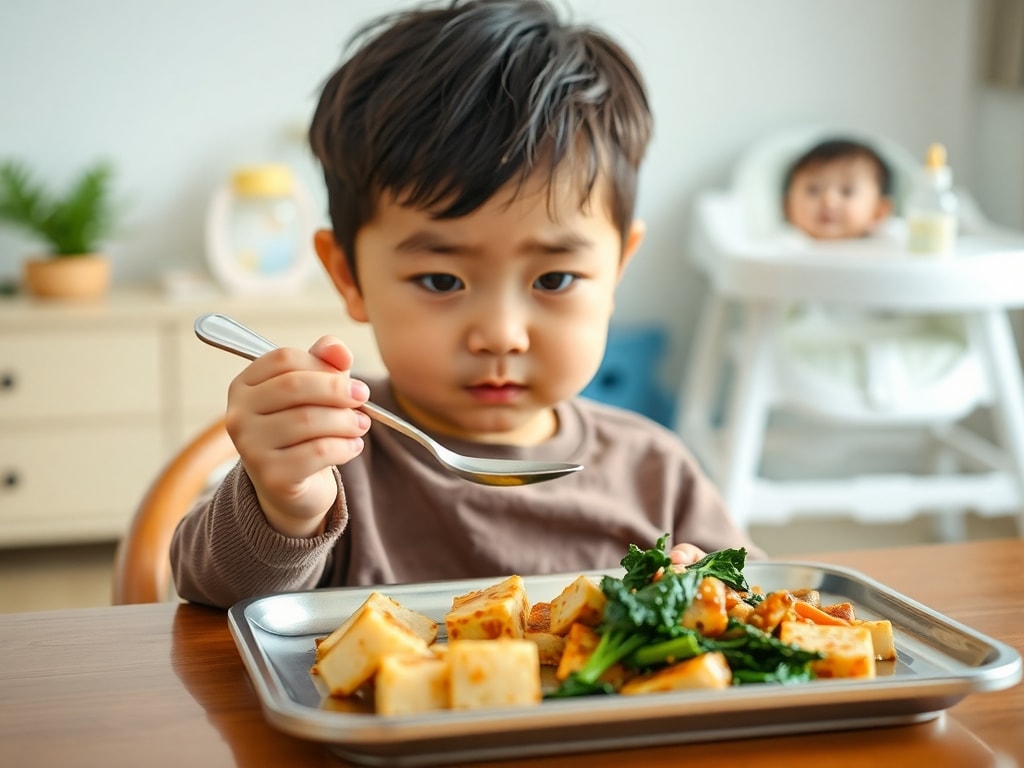
During this period, children often experience 'food neophobia,' which is a biological fear of new foods. This is thought to be an evolutionary survival mechanism to prevent mobile toddlers from eating poisonous plants. In my experience with this age group, side dishes are often rejected because they look 'messy' or 'unfamiliar.' I found that serving 1–2 tablespoons of a side dish in a separate compartment of a tray, rather than mixed with rice, reduced the overwhelm for a 1-year-old.
The 3–5 Year Window: The Power Struggle
By age 3 or 4, the refusal is less about fear and more about identity. This is the 'I do it myself' stage. If I tell my child they must eat their zucchini to get dessert, I have immediately framed the zucchini as a chore and the dessert as a reward. This lowers the value of the side dish in the child's mind. Instead, I have found success in giving the child a 'job' related to the side dish, such as washing the vegetables or choosing which bowl the side dish goes into. Giving them 2 specific choices (e.g., 'Do you want the carrots raw or steamed?') provides the autonomy they crave.
Common Misconceptions and Mistakes Parents Make
Many of us fall into the same traps when we are tired and just want our kids to be healthy. I have made several of these mistakes myself, only to realize they were making the problem worse in the long run.
- The 'One More Bite' Rule: Forcing a child to eat a certain amount often leads to a lifelong dislike of that food. It teaches the child to ignore their fullness cues. I have observed that when I stopped insisting on the 'one more bite' rule, my child actually became more curious about the food on my plate.
- Hiding Vegetables: While blending spinach into a smoothie can boost nutrients, it does not teach the child to like spinach. If the child discovers the hidden food, it can break the trust between parent and child. In my practice, I offer the food in its whole form alongside the 'hidden' version so they can see what it is.
- Short-Order Cooking: When my child refuses the side dishes, the temptation to go to the kitchen and make a grilled cheese sandwich is high. However, this teaches the child that the initial meal is optional. I now ensure there is at least one 'safe' food on the plate (like rice or fruit) and do not provide an alternative meal if the side dishes are left untouched.
- Over-serving Portions: We often give toddlers portions that are far too large. A standard serving of vegetables for a 2-year-old is only about 2–3 tablespoons. Seeing a large pile of something they are unsure of can cause them to shut down entirely.
Critical Caveats: When Advice May Not Apply
It is important to recognize that standard parenting advice for picky eating does not work for every child. There are specific scenarios where the 'wait it out' or 'division of responsibility' approach may fail or require modification.
Sensory Processing and ARFID
Some children have genuine sensory processing issues where certain textures cause a gag reflex or intense distress. Avoidant/Restrictive Food Intake Disorder (ARFID) is a recognized medical condition that goes beyond typical picky eating. If your child is losing weight, has a very limited range of 'safe' foods (fewer than 10–15 items), or experiences extreme anxiety at the sight of new food, the strategies in this article may not be sufficient. In these cases, it is vital to verify the situation with a pediatric occupational therapist or a feeding specialist.
The 'Starve Them Out' Myth
While I advocate for not cooking alternative meals, the advice to 'let them go hungry' can be dangerous for children with certain medical conditions, such as hypoglycemia or low weight percentiles. Every child's risk tolerance and physical health are different. For a child in the 5th percentile for weight, a skipped meal is a much bigger concern than for a child in the 75th percentile. You must use your judgment based on your child's growth history.

Decision Criteria for Mealtime Management
When deciding how to handle a mealtime strike, I recommend using the following two criteria to determine your approach:
Stress Level vs. Nutritional Need: If the battle over side dishes is causing the entire family to dread dinner, the psychological cost may outweigh the nutritional benefit of three pieces of broccoli. In those moments, I prioritize the family's emotional connection over the specific macro-nutrients consumed that evening.
Consistency of the Pattern: Is the refusal happening every meal, or just when the child is tired or the baby is fussy? If it is a consistent pattern, it requires a structural change in the routine. If it is sporadic, it might just be a sign of fatigue or a minor illness.
Summary and Next Steps
Managing a child who refuses side dishes, especially in a multi-child household, requires patience and a shift in perspective. To summarize the key points:
- Autonomy over Control: Refusing side dishes is often a way for a child to assert control during a time of change (like the birth of a sibling).
- Division of Responsibility: Your job is to provide the food; the child's job is to decide whether to eat it and how much.
- Exposure is Success: Simply having the side dish on the plate without a fight counts as a successful exposure, even if it isn't eaten.
Your Action Plan for Today
Today, I encourage you to take one specific action: Serve a 'micro-portion' of a rejected side dish. Instead of a full scoop, put just one single pea or one tiny sliver of a carrot on their plate. Tell them clearly, 'You do not have to eat this; it is just here for you to look at or smell if you want.' Then, do not mention the food again for the rest of the meal. Focus entirely on telling a story or asking about their day.
Proceed: Continue offering variety in small amounts and modeling healthy eating yourself.
Pause: Stop any rewards, punishments, or negotiations regarding the number of bites taken.
Verify: Consult your pediatrician if your child is consistently losing weight or showing signs of extreme sensory distress.
Previous
How to Build Lasting Organizing Habits in Your Eldest Child
Next
Side Dish Refusal in Toddlers: Strategies for Multi-Child Homes
More in Parenting
A Working Parent's Guide to Children's Eye Care: Protecting Your Firstborn's Vision
A practical guide for busy working parents on protecting their firstborn's vision. Learn how to spot early warning signs, set up healthy home lighting, and build simple routines.
Is It Puberty Rebellion or Teen Anxiety? A 2-Week Guide for Exhausted Parents
Unsure if your teenager is going through normal puberty or experiencing deep emotional anxiety? Discover the 2-week observation method and a daily 5-minute checklist.

Childhood Hives Causes and Management for School-Aged Kids
Childhood hives can be triggered by stress, temperature, or infection. Learn how to manage triggers and decide when your child is ready for school or daycare.

How to Build Lasting Organizing Habits in Your Eldest Child
Learn how to teach your eldest child sustainable organizing habits. This guide offers practical, no-nonsense strategies for working parents to manage toy clutter.