Study habits for lower elementary students: A step-by-step guide

Key Takeaways
Building study habits for lower elementary students requires a balance of consistency and patience. Learn how to create a routine that fits your child temperament.
Study habits for lower elementary students: A step-by-step guide
Disclaimer: The following information is provided for general educational purposes only and does not constitute professional educational counseling, psychological diagnosis, or medical advice. Every child develops at a different pace. Please consult with your child's teacher or a qualified developmental specialist for personalized guidance regarding learning disabilities or behavioral concerns.
Parents who view the first few years of school as a sprint toward academic achievement and parents who view it as a marathon of habit-building often end up with very different household environments. While one group may see immediate high marks on spelling tests, the other is quietly laying a foundation that will support the child through the much heavier workloads of middle and high school. The difference lies not in the amount of material covered, but in the structural integrity of the daily routine. Building study habits for lower elementary students is less about the 'what' and entirely about the 'how' and 'when.'
The story of the fifteen-minute timer
When my oldest child entered first grade, I approached his study time with the rigor of a drill sergeant. I assumed that because he was now a 'big kid,' he should be able to sit for 45 minutes and complete his workbook pages without standing up. The result was a nightly battle of wills that left us both exhausted and resentful. My child began to associate the very sight of his backpack with tension. I realized that I was trying to build a skyscraper on a foundation of sand. My expectations did not match his developmental reality.
Everything changed when I shifted the focus from the 'task' to the 'timer.' I introduced a simple 15-minute rule. For exactly 15 minutes, we would sit together at the kitchen table. He didn't even have to write; he just had to be in the space with a book or a pencil. In the beginning, he spent ten of those minutes just clicking his lead pencil. But because the time was non-negotiable and short, the resistance faded. By the end of the second week, he was finishing his math sheets within those 15 minutes because he knew the 'end' was guaranteed. This taught me that for a seven-year-old, the certainty of a finish line is more motivating than the promise of a good grade.
Now, with my second child in kindergarten and an 18-month-old climbing the chairs, I see that this habit-first approach is the only way to survive. My middle child has a completely different temperament—active, easily distracted, and prone to 'forgetting' instructions. Applying the same rigid 45-minute expectation would have been a disaster. Instead, we use a 5-minute 'check-in' habit. The lesson I learned is that the habit is the victory, not the completed worksheet.
Why are early study habits so difficult to establish?
In my experience, the primary reason parents struggle with this transition is a misunderstanding of a child's executive function. Lower elementary students (roughly ages 6 to 9) are still developing the ability to self-regulate, plan, and initiate tasks. Expecting them to 'just go do your homework' is like asking someone to fly a plane without looking at the manual. They lack the internal clock and organizational framework to manage their own time.
Furthermore, the jump from the play-based environment of preschool to the desk-based environment of primary school is jarring. According to a 2021 report by the National PTA and the National Education Association, the standard recommendation for homework is the '10-minute rule'—10 minutes of homework per night per grade level. This means a first grader should only be doing 10 minutes, and a third grader 30 minutes. Many parents, however, push for much more, leading to burnout before the child even hits age 10. When the workload exceeds the developmental capacity, the child's brain goes into a 'fight or flight' mode, making any actual learning impossible.
Another factor is the environment. In a classroom, there is peer pressure and a structured teacher-led environment. At home, there are toys, snacks, and the emotional safety to have a meltdown. Parents often mistake this 'home-version' of their child for laziness, when in reality, it is simply the child decompressing from the high-stress environment of school. Recognizing these hurdles is the first step in moving from conflict to cooperation.
What are the specific steps to build a daily routine?
To build a habit that sticks, you need to remove as much friction as possible. This involves a three-pillar system: Time, Space, and Task. If any of these pillars are unstable, the habit will likely collapse within a few weeks.
Pillar 1: The anchor time
Consistency is the most powerful tool in a parent's arsenal. A habit is something that happens automatically without a debate. To achieve this, you must anchor the study time to an existing habit. For example, 'We do 15 minutes of table time immediately after the afternoon snack.' By linking it to eating, you bypass the 'When do I have to do it?' argument.
In practice, this looks like:
3:30 PM: Arrive home and decompress.
4:00 PM: Healthy snack and 5 minutes of conversation.
4:10 PM: Clear the snack plate and start the timer.
4:25 PM: Timer rings, and the backpack is packed for the next day.
Pillar 2: The designated 'No-Stress' zone
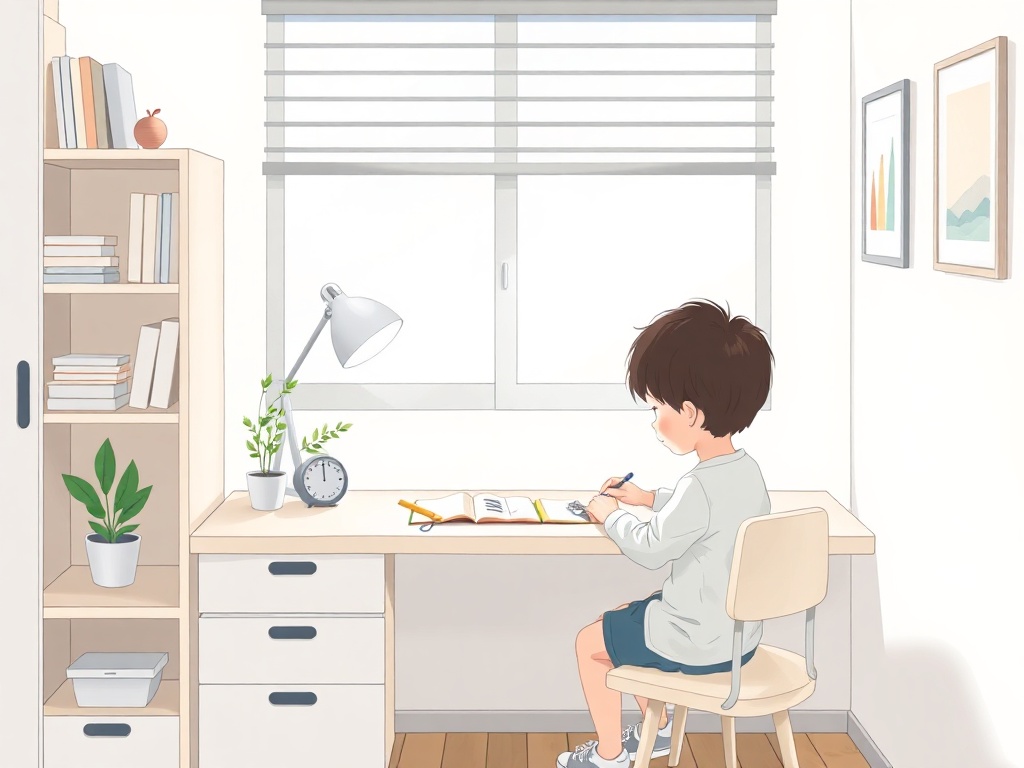
Where the study happens is just as important as when. While many parenting books suggest a quiet desk in a bedroom, I have found that for lower elementary kids, the kitchen table or a desk in a common area works better. Children at this age still crave 'body doubling'—the presence of an adult to keep them grounded.
Specifically, the space should have:
- A clear surface with no toys or electronics in sight.
- A dedicated 'tool kit' (pencils, eraser, sharpener, ruler) so they don't have to get up and wander to find supplies.
- Proper lighting to prevent eye strain.
- A chair where their feet can touch the floor or a footstool, as dangling feet lead to restlessness.
Pillar 3: The task-switching ritual
Starting is the hardest part. To help a child switch from 'play mode' to 'study mode,' use a sensory cue. This could be a specific desk lamp you turn on, a 1-minute breathing exercise, or a quick physical stretch. For my middle child, we do '3 big jumps' before sitting down. This physical ritual signals to the brain that a transition is occurring.
Implementation strategies for different temperaments
Not every child responds to a timer. In my experience across three different temperaments, you must customize the application. For the highly active child, the '15 minutes' might need to be broken into two 7-minute blocks with a 2-minute 'dance break' in between. For the perfectionist child who freezes when they make a mistake, the habit should focus on 'volume'—writing as many messy letters as possible in 5 minutes to lower the stakes of failure.
- The Distracted Learner: Use a visual timer (the ones with the red disc that disappears) so they can 'see' time moving. This reduces the frequency of them asking 'How much longer?'
- The Resistant Learner: Give them a choice within the habit. 'Do you want to do your math first or your reading first?' This small bit of autonomy can reduce power struggles by 50%.
- The Tired Learner: If your child is genuinely exhausted by 4:00 PM, consider moving the 15-minute habit to the morning before school. Some children are much more focused after a full night's sleep than after a long day of social interaction. related article
Critical caveats: When the standard method fails
It is important to recognize that a 'one size fits all' approach to study habits can be damaging if your child has underlying needs. There are several scenarios where the advice to 'just be consistent' might fail or even backfire.
Neurodivergence: If your child has ADHD, dyslexia, or sensory processing issues, a standard 15-minute sitting habit might be physically painful or mentally impossible. In these cases, the habit might need to be 'oral' (discussing what they learned) or 'active' (using a whiteboard while standing).
High-Stress Seasons: If there is a new baby in the house, a recent move, or a family illness, forcing a new study habit can lead to emotional outbursts. In these times, it is better to prioritize emotional connection over academic routine.
Mismatched Level: If the schoolwork is significantly too hard or too easy, the child will resist the habit because it is either discouraging or boring. You must verify with the teacher that the work assigned is at an 'independent' level—meaning the child should be able to do 80% of it without help.

Decision criteria for parents
Before you implement a new routine this week, use these two criteria to determine if your plan is sustainable:
1. The 'Parent Bandwidth' Criterion Can you realistically supervise this habit 5 days a week for the next month? If you choose a time when you are usually cooking dinner or handling a crying toddler, you will likely lose your patience, which will make the child hate the study time. Choose a time when you can be a calm, supportive presence.
2. The 'Success Rate' Criterion If your child is failing to complete the habit more than 3 times a week, the habit is too difficult. It is better to have a 2-minute habit that is successful 100% of the time than a 20-minute habit that is successful only 20% of the time. Success breeds confidence, and confidence fuels the habit loop.
Moving forward: Next steps for your household
Establishing these habits is a slow process of trial and error. You are not just teaching them math or reading; you are teaching them how to show up for themselves even when they don't feel like it. This is a life skill that transcends the classroom.
Proceed if your child is generally meeting developmental milestones and you have a consistent 20-minute window in your daily schedule to dedicate to this process.
Pause if your child is showing signs of extreme anxiety, physical tics, or aggressive refusal. These are signals that the current approach is causing more harm than good.
Verify with your child's teacher or a pediatrician if you suspect that the resistance is due to a learning gap or a physical issue like vision or hearing problems.
Conclusion
Building study habits in the lower elementary years is a long-term investment in your child's autonomy. Remember these three key points:
- Focus on the clock, not the content: In the beginning, the goal is simply sitting in the space for a set amount of time.
- Consistency over intensity: Five minutes every day is infinitely more effective than an hour once a week.
- Adapt to the child: Use visual timers for the distracted and movement for the active. Your specific action for today: Observe your child's energy levels after school. Do they seem 'wired' or 'tired'? Use this observation to pick an anchor time for a 10-minute study habit starting tomorrow. Do not worry about the quality of the work yet; just focus on the start time.
Previous
Crafting a Productive Winter Break for Teenagers: A Dad's Guide
Next
Study habits for lower elementary students: A step-by-step guide
More in Parenting
A Working Parent's Guide to Children's Eye Care: Protecting Your Firstborn's Vision
A practical guide for busy working parents on protecting their firstborn's vision. Learn how to spot early warning signs, set up healthy home lighting, and build simple routines.
Is It Puberty Rebellion or Teen Anxiety? A 2-Week Guide for Exhausted Parents
Unsure if your teenager is going through normal puberty or experiencing deep emotional anxiety? Discover the 2-week observation method and a daily 5-minute checklist.

Childhood Hives Causes and Management for School-Aged Kids
Childhood hives can be triggered by stress, temperature, or infection. Learn how to manage triggers and decide when your child is ready for school or daycare.

Side Dish Refusal in Toddlers: Strategies for Multi-Child Homes
Learn why children refuse side dishes after a second baby arrives and how to manage picky eating with age-specific strategies and consistent mealtime routines.