How to Apply for an International Travel Visa for Your Family

Key Takeaways
Learn how to apply for an international travel visa for your family. This guide covers documentation for minors, processing times, and common pitfalls to avoid.
How to Apply for an International Travel Visa for Your Family
If you've ever spent three hours scouring government websites only to realize you're missing a notarized birth certificate for your toddler, you know that family visa applications are a different beast than solo travel. While a solo traveler might breeze through an electronic authorization system, parents often face a mountain of paperwork including proof of relationship, consent forms, and specific photo requirements for infants who cannot yet sit up straight. The stress of potentially having a child's visa rejected while the parents' are approved is enough to make anyone reconsider a staycation. This guide provides general information regarding the application process for international travel visas and should not be taken as legal or official immigration counsel. Always verify current requirements with the official embassy or consulate of your destination country.
Why is the family visa process so complicated?
The root cause of the complexity in family visa applications often stems from international child safety regulations and the varying legal definitions of guardianship. Governments are extremely cautious about the movement of minors across borders to prevent child abduction and trafficking. This results in a requirement for extensive 'proof of intent' and 'proof of relationship' that single travelers simply do not encounter.
In my experience as an office worker who meticulously plans weekend and holiday trips, I have noticed that the administrative burden increases exponentially with every family member added to the itinerary. For a solo trip, I handle one set of forms. For a family of four, that is four sets of forms, four sets of identical photos, and often multiple original documents that must be handled with care.
Another cause for delay is the lack of uniformity. While some countries allow a family to apply under a single 'group' profile, others require a completely separate account and appointment for every individual, including newborns. This can lead to a situation where a parent secures an appointment at 10:00 AM, but the only available slot for the child is three days later. Furthermore, the shift toward digital E-visas has not fully eliminated the need for physical paperwork; many nations still require physical 'sticker' visas for minors even if adults can apply online.
How to navigate the application steps successfully
To manage this process without losing your sanity, you must approach it with the precision of a project manager. The following steps are based on common requirements for major travel destinations as of early 2026.
Step 1: Audit all passports for the six-month rule
Before you even look at a visa form, check every family member's passport expiration date. Most countries require that your passport be valid for at least 6 months beyond your intended date of departure. I once saw a family at the airport turned away because the father's passport expired in 5 months, even though the trip was only 10 days long. For children, passports often expire every 5 years rather than the 10 years standard for adults, making them much easier to overlook.
Step 2: Determine the visa type and platform
You need to identify if your destination uses an Electronic Travel Authorization (ETA), an E-visa, or a traditional sticker visa.
- ETA: Usually a quick online form for visa-exempt countries (e.g., K-ETA for Korea or ESTA for the US). Approval often takes 24–72 hours.
- E-visa: A more digital version of a regular visa where you upload scans of your documents. Approval typically takes 5–10 business days.
- Sticker Visa: Requires mailing your physical passport or visiting an embassy. This can take 15–30 business days.
Step 3: Gather the 'Minor-Specific' documentation
This is where most parents encounter friction. You will likely need the following 4 items specifically for your children:
Full Birth Certificate: A copy is rarely enough; most consulates want to see the original or a notarized copy showing both parents' names.
Notarized Consent Form: If only one parent is traveling, or if children are traveling with grandparents, a signed and notarized letter of consent from the non-traveling parent(s) is almost always mandatory.
School Enrollment Letter: For school-aged children, some countries ask for a letter from the school confirming the child is a student and has permission to be absent.
Financial Guarantee: Since children do not have income, you must provide 3–6 months of your own bank statements to prove you can support them during the trip.
Step 4: Master the infant visa photo
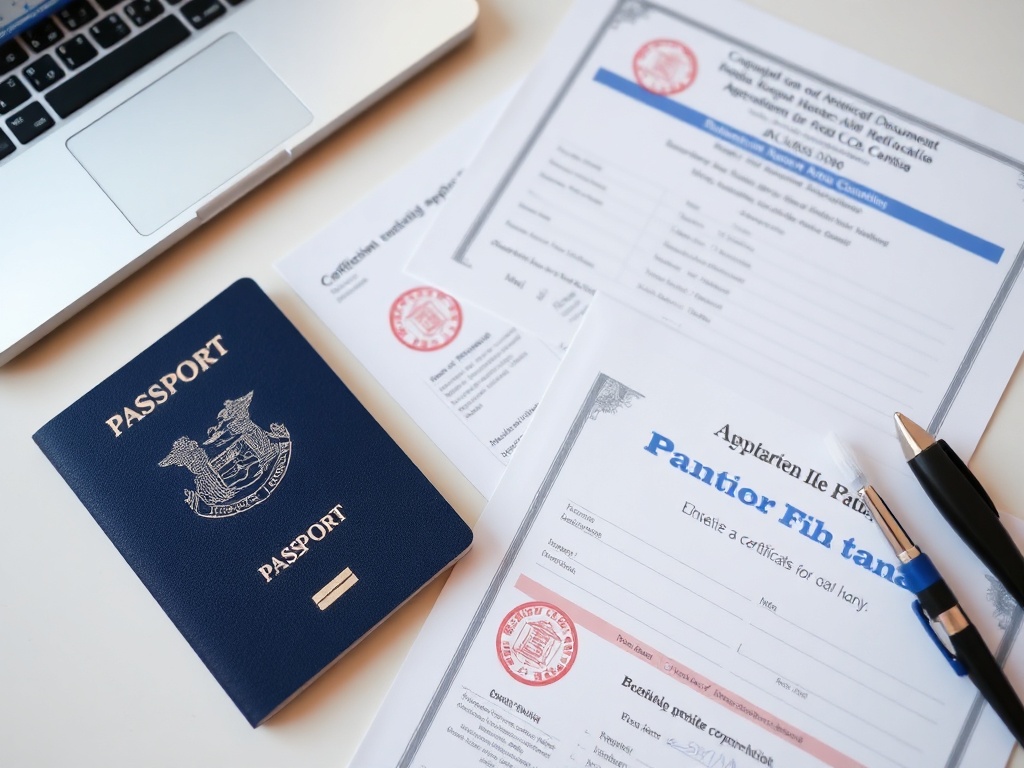
Taking a visa photo of a baby is notoriously difficult. The rules are strict: no hands in the frame, eyes open, neutral expression, and a plain white background. In my experience, it is easier to lay the baby on a white sheet on the floor and take the photo from above rather than trying to hold them up. Ensure there are no shadows on the face, as this is a common cause for digital rejection by automated systems.
Step 5: The submission and payment
Double-check the payment methods. Many embassies do not accept credit cards or personal checks at the window. You may need a money order or a specific type of bank draft. If you are applying for 4 people and the fee is 80 dollars each, ensure you have exactly 320 dollars in the required format.
How to prevent visa delays and rejections
Prevention is entirely about timing and organization. The most common reason for rejection is not a lack of eligibility, but simple clerical errors or missing signatures.
First, create a 'Travel Master Folder.' This should contain digital scans and physical copies of every document mentioned above. Having a travel planning checklist can help you keep track of which child has which document ready. I personally keep a spreadsheet that tracks the 'Date Applied,' 'Reference Number,' and 'Expected Return Date' for every family member's application.
Second, apply early but not too early. Most visas have a 'validity window' (often 90 days). If you apply 6 months in advance, the visa might expire before your trip even begins. The sweet spot is usually 8–10 weeks before departure. This allows for a 3-week processing delay while still keeping you within the validity window.
Third, verify the 'Entry Type.' If your family trip involves crossing borders (for example, flying into France, visiting the UK, and returning to France), you must apply for a 'Multiple Entry' visa. A 'Single Entry' visa will become void the moment you leave the Schengen area for the UK, and you will be stuck at the border trying to get back in.
Critical caveats and when the advice may fail
It is important to recognize that visa policies are subject to sudden geopolitical changes. What worked for a friend last year may not work for you today.
When this advice may not apply
- Dual Citizenship: If your child holds dual citizenship, the rules change entirely. They may be required to enter a country on a specific passport, or they may be exempt from visa requirements that apply to you.
- Custody Disputes: If there is a legal custody agreement in place, a standard notarized consent form may not be sufficient. You may need to provide the actual court order specifically permitting international travel.
- Political Backlogs: During peak seasons or after political shifts, processing times can jump from 10 days to 60 days without warning. In these cases, no amount of 'correct' paperwork will speed up the bureaucratic machine.
Criteria for decision making
When deciding how to apply, consider these two criteria:
Risk Tolerance vs. Cost: If your trip is 3 weeks away, the risk of a mistake is high. Paying an extra 150–200 dollars for an expedited agency service might be worth the peace of mind. If your trip is 4 months away, you can afford to save that money and handle the process yourself.
Convenience vs. Control: Applying in person at an embassy gives you a receipt and immediate confirmation that your documents were accepted. Applying by mail is more convenient but leaves you in the dark for weeks while your family's most important identity documents are in transit.
Recommended stops near the consulate district
If you have to visit a consulate in person, you will likely find yourself in a major city's central business district. Waiting for your appointment or a same-day pickup can be exhausting with kids.
- The Quiet Bakery: Often found just a block away from major embassies, these spots are perfect for a quick croissant and coffee. Expect to pay about 5–10 dollars per person. It is a great place to double-check your paperwork one last time in a calm environment.
- The Sandwich Hub: For a more substantial lunch after your appointment, look for a local deli or sandwich shop within a 5-minute walk. These are usually geared toward office workers, meaning they are fast and efficient. A full meal usually runs between 12–18 dollars. It fits perfectly into a morning sightseeing flow before or after your scheduled visa slot.

What readers may miss: The 'Apostille' requirement
Many parents assume a 'notarized' document is the final step. However, for many international visas, a notary's signature is not enough. You may need an 'Apostille,' which is a specialized certificate issued by a state or national government that authenticates the notary's seal for use in another country. This process can add an extra 7–14 days to your timeline. If your destination country is part of the Hague Convention, check if your birth certificates or consent letters require this extra layer of authentication. Failing to get an Apostille is one of the most common reasons for family visa denials at the final stage of review.
Conclusion
Securing an international travel visa for a family requires a blend of early preparation, strict attention to detail, and a bit of patience for bureaucratic hurdles. To ensure a smooth process, remember these three points:
- Verify the 6-month passport rule for every family member immediately.
- Consolidate all minor-specific documents, including notarized consent forms and original birth certificates.
- Build a 2-week buffer into your timeline to account for unexpected mail delays or document requests. Your specific action to take today: Open every passport in your household and write down the expiration dates. If any expire within the next 8 months, book a passport renewal appointment before you even begin the visa application process.
Previous
Kuala Lumpur Travel Guide: Essential Packing and Preparation
Next
How to Apply for an International Travel Visa for Your Family
More in Travel

Slow Travel with Pets: A 4N5D Low-Walking Guide to Gangneung and Yangyang
Plan a relaxed 4-night, 5-day pet-friendly trip to Gangneung and Yangyang. Discover low-walking itineraries, budget tips, and safety checklists.
1N2D Couple's Travel: The Ultimate Food Allergy Survival Guide
Plan a safe 1-night, 2-day couple's trip abroad. Learn how to manage food allergies using public transit, prepare emergency cards, and build a backup plan.

Hanok Stays: Easy Transit Solo Travel Guide
Discover charming Korean Hanok stays accessible by public transit. Prioritize pace and ease on your solo or friends' weekend trip, avoiding car dependency.

Sick child during overseas travel: Managing care and costs
Learn how to manage a sick child during overseas travel when peak season bookings are full. Discover emergency alternatives, cost-saving tips, and next steps.